Choosing the right psi for 2025 Chevy truck tires is more important than many drivers realize. Tire pressure is not just a number—it affects your truck’s safety, performance, fuel economy, and even how long your tires last. Many owners set tire pressure by habit or guesswork, but the correct psi can change depending on your truck model, load, and driving conditions. Let’s break down how to find the ideal psi, why it matters, and what happens if you ignore this critical detail.
Understanding Psi: What Does It Mean For Chevy Truck Tires?
PSI stands for pounds per square inch. It measures the air pressure inside your tires. Every tire and vehicle is designed to operate best within a certain psi range. If the psi is too low or too high, you risk poor handling, uneven tire wear, and even tire failure.
For the 2025 Chevy truck, the recommended psi is usually printed on a sticker inside the driver’s door or in the owner’s manual. Most Chevy trucks recommend 35 psi for standard driving conditions, but this can vary based on tire size, trim level, and whether you’re carrying heavy loads.
Why The Right Psi Matters For Your Chevy Truck
The correct psi affects:
- Safety: Under-inflated tires can overheat and may blow out. Over-inflated tires can reduce traction and make the ride harsh.
- Fuel efficiency: Too low psi increases rolling resistance, making your truck use more fuel.
- Tire lifespan: Incorrect psi causes uneven wear. Tires last longer when inflated to the right pressure.
- Handling: Proper psi keeps your Chevy stable and predictable on the road.
Here’s a quick comparison of tire performance at different psi levels:
| PSI Setting | Effect on Performance | Risk Level |
|---|---|---|
| Too Low (25-30 psi) | Poor fuel economy, sluggish handling | High (blowouts, wear) |
| Recommended (35 psi) | Optimal grip, best mileage, even wear | Low |
| Too High (40-45 psi) | Stiff ride, reduced traction | Medium (loss of control) |
How To Find The Recommended Psi For Your 2025 Chevy Truck
The best way to find the recommended psi is:
- Check the door sticker: Most 2025 Chevy trucks have a label inside the driver’s door showing tire size and psi.
- Owner’s manual: Look for the tire pressure section.
- Chevy website: Use their online tools for your exact model and tire size.
- Ask your dealer: Dealers can confirm the correct pressure for your specific truck.
Most 2025 Chevy trucks, including Silverado, Colorado, and Chevy 2500HD, suggest 35 psi for regular tires. However, larger or off-road tires may need different settings, often in the 35-45 psi range.
Adjusting Psi For Different Loads And Conditions
Your Chevy truck’s psi isn’t always “one size fits all.” Here are a few examples:
- Heavy loads or towing: Increase psi by 3-5 pounds for extra weight. For example, if your normal psi is 35, use 38-40 psi when towing.
- Off-road driving: Lower psi to 28-30 for better grip on loose surfaces, but raise it back for highway driving.
- Cold weather: Air contracts in cold, so psi drops. Check tire pressure often in winter.
Here’s a simple table for adjusting psi based on load:
| Driving Condition | Suggested PSI |
|---|---|
| Normal/Empty | 35 psi |
| Heavy Load/Towing | 38-40 psi |
| Off-Road | 28-30 psi |
| Cold Weather | Check every 2 weeks |
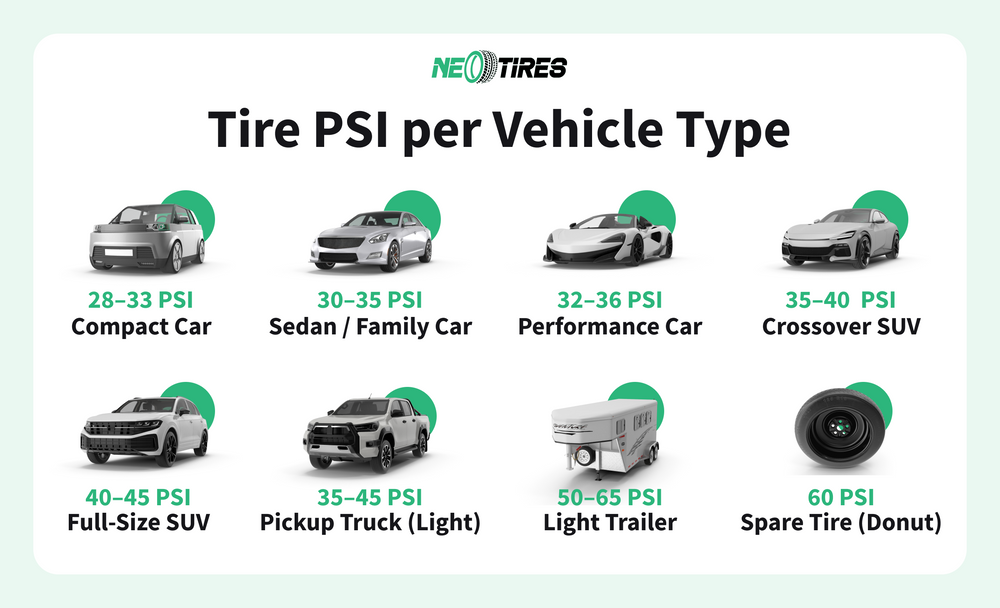
Credit: neotires.com
Step-by-step Guide To Checking And Setting Tire Psi
Keeping your tires at the right psi is simple but must be done regularly. Here’s how:
- Buy a good tire gauge: Digital or analog both work well.
- Check tires when cold: Measure psi before driving, when tires are cool.
- Find the recommended psi: Use the door sticker or manual.
- Remove the valve cap: Place the gauge on the valve stem.
- Read the pressure: Compare to the recommended psi.
- Add or release air: Use a compressor or air pump at gas stations.
- Recheck and adjust: Repeat until you hit the correct number.
- Replace the cap: Keep dirt out of the valve.
Most tire shops offer free pressure checks. Don’t forget to check the spare tire—it’s often overlooked!
Common Mistakes When Setting Psi
Many Chevy truck owners make mistakes with tire psi. Here are some you should avoid:
- Using the max psi on the tire sidewall: This is the tire’s maximum, not your truck’s recommended.
- Ignoring seasonal changes: PSI drops in winter and rises in summer.
- Only checking one tire: All four should be checked at the same time.
- Setting psi after driving: Hot tires give false readings.
- Not adjusting for load/towing: Failing to increase psi can cause dangerous handling.

Credit: www.reddit.com
Real-world Example: Impact Of Incorrect Psi
Let’s say you drive a 2025 Chevy Silverado, and your tires are set at 25 psi instead of 35 psi. You notice:
- Steering feels heavy
- Fuel economy drops by 5–10%
- Tires wear out faster on the edges
- Risk of blowout increases, especially at high speeds
On the other side, setting your tires at 45 psi instead of 35 psi can make your ride harsh, reduce grip in wet conditions, and cause the center of your tires to wear faster. Balance is key.
Psi Differences By Chevy Truck Model
Chevy trucks come in different sizes and trims. Here’s a quick overview:
- Chevy Silverado 1500: 35 psi for standard tires
- Chevy Colorado: 35 psi, but some trims with larger tires recommend 38 psi
- Chevy Silverado 2500HD: 40 psi for heavy-duty tires; 35 psi for standard
- Chevy Silverado 3500HD: Up to 45 psi for rear tires when towing
Always check your specific model and tire size. Trucks with aftermarket tires or wheels may require a different psi.

Credit: www.yourhometownchevy.com
Psi And Tire Types: All-terrain Vs Highway
The type of tire on your Chevy truck affects the ideal psi:
- Highway tires: 35 psi is common for smooth roads and best mileage.
- All-terrain tires: May need 38–40 psi for highway; lower psi (28–32) for off-road.
- Mud tires: Often run at lower psi for grip, but always adjust back for pavement.
If you switch tire types, check the manufacturer’s recommendations and test your truck’s handling at different psi levels.
Psi And Tire Maintenance Tips
Beyond setting psi, good tire care means:
- Rotate tires every 5,000–8,000 miles
- Balance and align wheels
- Inspect for damage, nails, or bulges
- Replace tires when tread depth is below 2/32 inch
- Check psi monthly, not just at oil changes
Keeping tires at the right psi makes all other maintenance easier and more effective.
Psi Monitoring Technology In 2025 Chevy Trucks
Newer Chevy trucks feature TPMS (Tire Pressure Monitoring System). This system alerts you when psi drops below safe levels. However, it’s still important to check manually, since TPMS may not catch slow leaks or differences between tires.
TPMS can help prevent accidents and save money by keeping your tires healthy. If your TPMS light comes on, check all four tires immediately.
Data: Psi Vs Tire Wear
Research shows that driving with tires 10 psi below the recommended level can reduce tire life by up to 25%. Over-inflating by 10 psi can cause the center tread to wear out 20% faster. Proper psi saves money and keeps you safe.
| PSI Deviation | Tire Life Impact | Safety Risk |
|---|---|---|
| -10 psi | -25% tread life | High (blowout risk) |
| +10 psi | -20% center wear | Medium (traction loss) |
| Recommended | Full tire life | Low |
Expert Tips For Chevy Truck Tire Psi
- Always use the recommended psi for your truck and tire size.
- Check psi monthly or before any long trip.
- Adjust for heavy loads—don’t forget to increase psi if you’re hauling or towing.
- Buy a quality tire gauge—cheap gauges can be inaccurate.
- Don’t forget the spare—many drivers never check it.
Non-obvious tip: If you notice one tire always losing pressure, it may have a slow leak. Get it checked before it becomes a big problem.
Another insight: If you regularly drive on gravel or rough roads, rotate your tires more often. Uneven surfaces can cause faster wear, especially if psi isn’t set correctly.
Where To Find Official Chevy Psi Information
The most reliable sources are:
- Owner’s manual
- Driver’s door sticker
- Official Chevy website
- Local Chevy dealer
For more detailed tire and psi information, see the Chevrolet official site.
Frequently Asked Questions
What Is The Recommended Psi For 2025 Chevy Silverado Tires?
Most Silverado 2025 models recommend 35 psi for standard tires. If you have larger or heavy-duty tires, check your owner’s manual or door sticker for the exact number.
Should I Change Psi When Towing With My Chevy Truck?
Yes. Increase psi by 3–5 pounds for towing or carrying heavy loads. For example, use 38–40 psi instead of 35 psi when towing.
How Often Should I Check My Chevy Truck’s Tire Pressure?
Check your tire pressure at least once a month and before any long trip. Also, check after big temperature changes, as psi can drop in cold weather.
Is It Safe To Use The Maximum Psi Printed On The Tire?
No. The max psi on the tire is for the tire itself, not your truck. Always use the psi recommended by Chevy for your vehicle.
What Happens If My Tire Psi Is Too Low Or Too High?
Low psi causes poor fuel economy, uneven wear, and blowout risk. High psi makes the ride harsh, reduces traction, and wears the tire center faster. Always aim for the recommended psi for the best results.
Keeping your 2025 Chevy truck tires at the right psi is a simple step that makes a big difference. It improves safety, saves money, and keeps your truck running its best. Don’t rely on guesswork—check your psi regularly, adjust for load and conditions, and enjoy the full power and reliability your Chevy was built to deliver.